How to read Praise and Worship TABS
As shown in the diagram below, tablature has six lines. Each line represents one string. The top string represents the first string on the guitar. The bottom string represents the 6th string. For a bass guitar, the praise and worship TABS would have just four lines, representing the four strings.
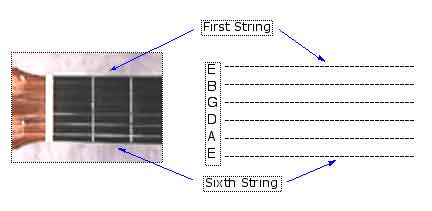
The frets for praise and worship tabs are represented with numbers. 0 is no fret, or the open string. 1 is the first fret, 2 is the second fret, etc.
E- – – – – -3- 3 – 5- 5- -3 – – –
B- -1- 1 – – – – – – – – – – – – –
G- – – – – – – – – – – – – – – – – –
D- – – – – – – – – – – – – – – – – –
A- – – – – – – – – – – – – – – – – –
E- – – – – – – – – – – – – – – – – –
Do you recognize this tune? It starts on the second string, first fret. Play it twice than jump up to the first string, third fret. Like a book, tablature reads from right to left. This first example was a single note melody. For chords, you just stack the numbers.
E- – – -2 – – – – – – – – – – – – –
B- – – -3 – – – – – – – – – – – – –
G- – – -2- – – – – – – – – – – – –
D- – – -0- – – – – – – – – – – – –
A- – – – – – – – – – – – – – – – – –
E- – – – – – – – – – – – – – – – – –
Do you recognize this chord? It’s a D chord, a common one in praise and worship tabs.
There are other symbols that you could encounter in praise and worship tab. Two are the hammer on, h, and pull off, p. These are both made with the left hand, or hand holding down the strings.
A hammer on is when you pluck the initial note with your left hand, but make the next note sound by hammering on it with a finger from your left hand. Here’s a blues scale with hammer ons.
BLUES SCALE...
E- – – – – – – – – – – – – – – – – – – – – – – – 0h3- – – – –
B- – – – – – – – – – – – – – – – – – – – -0h3- – – – – – – –
G- – – – – – – – – – – – – – – – 0h2- – – – – – – – – – – – –
D- – – – – – – – – – – -0h2 – – – – – – – – – – – – – – – – –
A- – – – – – -0h2 – – – – – – – – – – – – – – – – – – – – – –
E- – 0h3- – – – – – – – – – – – – – – – – – – – – – – – – – –
Pluck the 6th string open, then with all your strength hammer it with the 3rd finger of your left hand, hit the third fret, etc.
Pull offs are just the reverse. Again plug the note using your right hand, but then plug it with the finger you’re using to hold the note, on the left hand. You’ll see both these symbols in praise and worship tabs.
Here’s that scale in reverse, using pull offs.
E- – 3p0- – – – – – – – – – – – – – – – – – – – – – – – – – –
B- – – – – – 3p0- – – – – – – – – – – – – – – – – – – – – – –
G- – – – – – – – – – – 2p0- – – – – – – – – – – – – – – – – –
D- – – – – – – – – – – – – – – -2p0 – – – – – – – – – – – – –
A- – – – – – – – – – – – – – – – – – – – 2p0- – – – – – – – –
E- – – – – – – – – – – – – – – – – – – – – – – – – 3p0- – – –
Bends, b, and returns, r, work best on electric guitars. If you see, for example 11b13. That means to pluck the 11th fret, then bend it to the pitch that would sound on the 13th fret. That’s easy on electric guitars because the strings are so thin. Not as easy on higher tension acoustic guitar strings. The r stand for releasing the bend.
Slides are written with either an s or a slash, / or \\\\\\\\. A slide is again where you pluck the first note with your right hand, but get to the next note by keeping the weight down with your left hand and literally sliding it to the next note. You’ll hear all the notes between them. 5/8 would mean to pluck the 5th fret, then slide up to the 8th fret with the finger holding the string down.
A v stands for vibrato, shaking the note with your left hand. A t stands for tap. You tap with the strumming hand. And the x stands for a muted string.
Leave a Reply